Persistent hunger isn’t a failure of willpower; it’s a biological reflex that can easily overpower disciplined nutrition plans. If you’re seeking phentermine for appetite control Fort Lauderdale clinical practices provide, you likely want reliable relief from constant hunger alongside absolute medical transparency. It’s completely reasonable to feel cautious about Florida controlled substance regulations or potential cardiovascular side effects when exploring prescription therapies on your own.
Prescription appetite suppression serves as a clinical bridge to establishing sustainable daily routines rather than an isolated shortcut. In this guide, you’ll discover how phentermine regulates central nervous system appetite signals under direct physician oversight and how diagnostic standards confirm your candidacy. We review Florida statutory guidelines, essential safety monitoring, and the structured in-person evaluation process you can expect at a trusted Broward County clinic.
Key Takeaways
- Understand how phentermine stimulates norepinephrine release within the hypothalamic satiety center to mute persistent hunger cues and simplify portion management.
- Learn the specific diagnostic standards required to qualify for phentermine for appetite control Fort Lauderdale physicians evaluate, including Florida BMI benchmarks and health indicators.
- Examine the critical cardiovascular protocols, including baseline blood pressure tracking and resting pulse checks, mandated by Florida law to ensure patient safety.
- Discover the benefits of structured, physician-directed oversight under Dr. Jacob Harris, MD, in a LegitScript-certified Broward County setting with verified on-site dispensing.
How Phentermine Regulates Appetite Signaling and Daily Hunger
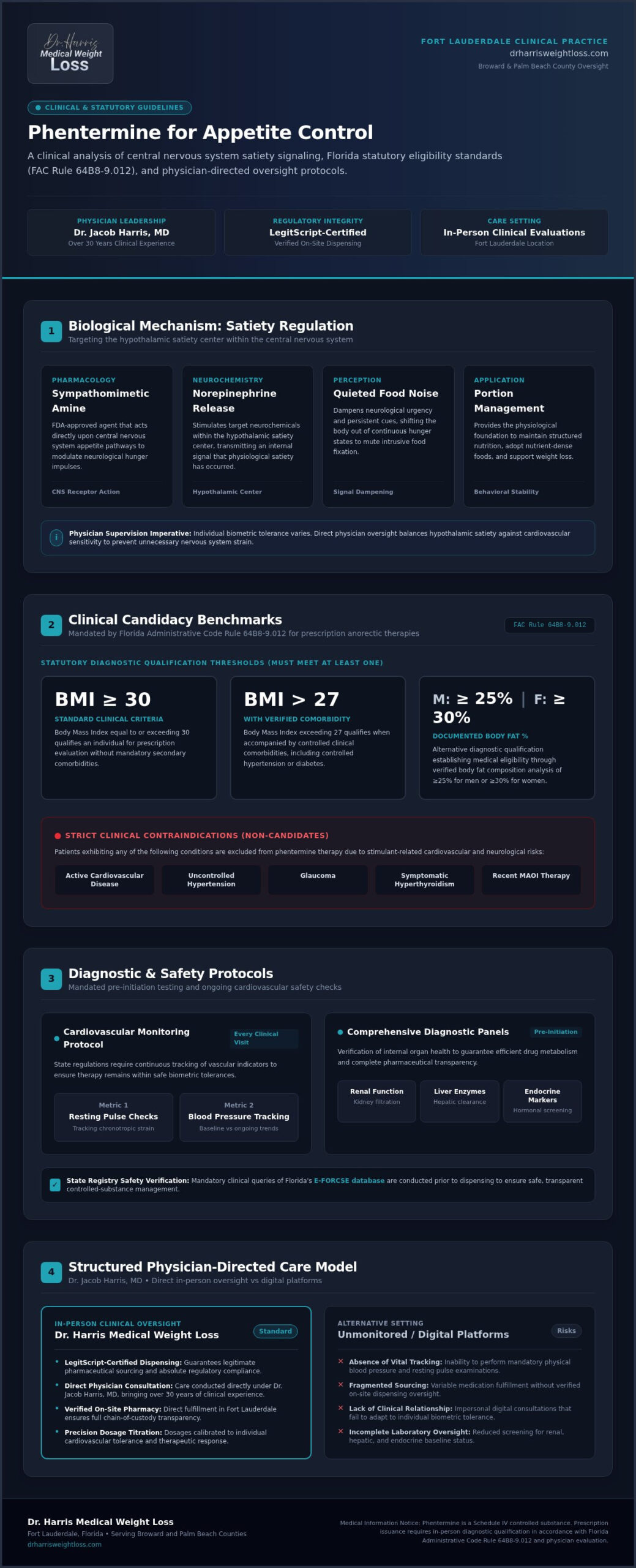
Phentermine operates as an FDA-approved sympathomimetic amine that targets the hypothalamic satiety center within the central nervous system. By stimulating the release of norepinephrine, the medication signals the brain that the stomach is satisfied, effectively shifting the body out of persistent hunger states. This biological mechanism dampens the constant neurological urgency to eat that often derails disciplined nutrition plans. Detailed analysis of how phentermine works shows that suppressing these signals silences intrusive food noise. When patients utilize phentermine for appetite control Fort Lauderdale clinical settings provide, this quieted mental state empowers them to develop sustainable portion management, choose nutrient-dense whole foods, and build consistent eating patterns without white-knuckling through physical deprivation.
The Role of Medical Supervision in Appetite Management
Individual biometric tolerance varies significantly across patients, which makes structured medical supervision indispensable. A physician initiates care with precise dosage titration, balancing hypothalamic satiety against cardiovascular sensitivity to prevent unnecessary nervous system strain. Scheduled check-ins allow your provider to track resting heart rate, monitor blood pressure trends, and verify therapeutic efficacy at predictable intervals. This ongoing clinical relationship connects pharmacological appetite regulation directly to daily routines. With biological hunger muted under close observation, patients gain the stability needed to adhere to structured meal plans, transforming temporary appetite control into durable behavioral changes that support weight loss over time.
Clinical Candidacy and Medical Evaluation Standards in Florida
Florida Administrative Code Rule 64B8-9.012 establishes rigorous qualifying criteria for prescription anorectic therapies. Candidates must present a Body Mass Index (BMI) of 30 or higher, or a BMI above 27 with an accompanying comorbidity such as controlled hypertension or diabetes. Alternatively, a documented body fat percentage of at least 25% for men or 30% for women establishes medical eligibility. When evaluating candidates for phentermine for appetite control Fort Lauderdale physicians adhere to established federal and state Medical Evaluation Standards to screen out contraindications. Patients with active cardiovascular disease, uncontrolled hypertension, glaucoma, symptomatic hyperthyroidism, or recent monoamine oxidase inhibitor therapy aren’t candidates for this therapy due to stimulant-related risks.
Diagnostic Screenings Conducted Before Treatment Initiation
Every clinical intake incorporates thorough diagnostic screenings to verify internal organ health before therapy begins. Clinicians review personal health histories, examine current medication profiles, and query Florida’s E-FORCSE database to ensure safe, transparent dispensing. Comprehensive laboratory panels assess renal function, liver enzymes, and endocrine markers, confirming the body can metabolize the treatment efficiently. Vital sign tracking forms an ongoing baseline; resting pulse and blood pressure measurements are documented at every visit to protect vascular wellness. These precise diagnostic checkpoints protect patient vitality while creating structured support for weight loss. For individuals seeking expert guidance in Broward County, exploring your candidacy through Dr. Harris Medical Weight Loss ensures your care adheres to strict physician oversight.
Physician-Directed Care at Dr. Harris in Fort Lauderdale
Receiving medical oversight from an experienced practitioner transforms therapeutic management into a safe, collaborative partnership. At Dr. Harris Medical Weight Loss, care is led directly by Dr. Jacob Harris, MD, who brings over 30 years of clinical experience treating patients throughout Broward and Palm Beach counties. Rather than relying on faceless digital platforms, the clinic maintains a LegitScript-certified dispensing environment that guarantees legitimate pharmaceutical sourcing and strict compliance with state regulations. When pursuing Physician-Directed Care, having on-site pharmacy dispensing ensures complete transparency from initial intake to medication fulfillment. In-person appointments in Fort Lauderdale build direct accountability, giving patients consistent access to an experienced clinician who monitors physiological responses at every stage.
Accessing Individualized Medical Programs in Broward County
Your journey begins with an initial in-office evaluation designed to assess your medical history, daily routines, and metabolic health. Dr. Harris develops customized treatment plans tailored to individual health requirements, offering independent clinical pathways that include phentermine alongside advanced options like a Semaglutide Medication Program or a Tirzepatide Program. Patients seeking phentermine for appetite control Fort Lauderdale practices deliver can easily schedule an in-person consultation at the clinic. This face-to-face evaluation provides diagnostic clarity, aligns pharmacological interventions with sustainable lifestyle changes, and establishes the medical structure necessary for lasting vitality.
Restore Healthy Balance with Physician-Led Care
Regulating biological hunger is an essential step toward restoring physical balance and establishing sustainable nutrition habits. When you choose phentermine for appetite control Fort Lauderdale physicians offer, you receive targeted neurological relief from constant cravings alongside structured medical oversight. Adhering to Florida’s diagnostic standards ensures your cardiovascular system remains thoroughly protected while you focus on building healthy routines.
With over 30 years of medical practice in South Florida, Dr. Jacob Harris, MD, conducts thorough evaluations to design safe, individualized programs for weight loss. Our LegitScript-certified clinical office provides ethical on-site dispensing with direct physician supervision throughout your treatment. You don’t have to manage chronic hunger signals alone. Take a decisive step toward lasting vitality and schedule your consultation with Dr. Harris in Fort Lauderdale today.
Frequently Asked Questions
How does phentermine reduce hunger during medical treatment?
Phentermine acts directly on the central nervous system by triggering the release of norepinephrine. This neurotransmitter stimulates neurons within the brain’s satiety center, effectively signaling that the body is nourished. By muting intense biological hunger signals, it prevents overwhelming cravings throughout the day. This steady neural suppression gives patients the clarity needed to adopt controlled meal routines comfortably.
Who qualifies for prescription appetite suppressants in Florida?
Florida clinical standards require candidates to have a Body Mass Index of 30 or higher, or a BMI of 27 with an accompanying condition such as diabetes or managed hypertension. Qualified body fat measurements can also establish eligibility. When prescribing phentermine for appetite control Fort Lauderdale physicians confirm these metrics and query state prescription registries before approving treatment.
What cardiovascular monitoring is required while taking phentermine?
Because phentermine is a sympathomimetic medication, routine cardiovascular monitoring is medically necessary. Clinicians evaluate your resting heart rate and blood pressure at every visit to detect subtle vascular changes. Prescribers also screen out pre-existing heart disease, uncontrolled high blood pressure, and cardiac arrhythmias during intake to ensure your cardiovascular system functions safely under therapy.
How long is phentermine typically prescribed during weight management?
Phentermine is FDA-approved for short-term use, generally spanning up to 12 weeks as part of a medically directed plan for weight loss. Under Florida regulations, re-evaluations occur at least every three months to verify therapeutic safety. In Broward County, ongoing clinical assessments ensure the medication serves as an effective bridge toward enduring lifestyle adaptations.