Progress doesn’t depend on medication alone; it depends on care that continues as your needs change. That’s central to long term success with medical weight loss. It’s understandable to wonder whether progress will hold, what role medication should play over time, and how to approach treatment if your needs change.
Clinical follow-up gives you a place to review progress, discuss treatment experiences, and raise questions with a clinician. Routines around meals, movement, and sleep can also help make your plan workable in daily life. This article explains what ongoing oversight can involve, how to build routines that fit your circumstances, and how to discuss treatment changes with your clinician. With clear guidance and manageable habits, you can approach each stage with confidence and discuss changes in treatment as part of your care.
Key Takeaways
- Support long term success with medical weight loss by reviewing progress in context rather than relying on a single scale reading.
- Use follow-up visits to discuss your health context, treatment experience, and questions with your clinician.
- Choose routines for meals, movement, sleep, and tracking that fit your daily life, then adjust them as needed.
- Discuss medication changes or stopping treatment with your prescribing clinician, and bring notes about changes and concerns to your visit.
Medical Weight Loss and Long-Term Success: What Does Ongoing Care Add?
Progress is more than a number on the scale. A useful review considers changes over time alongside your health, daily functioning, treatment experience, and routines. One reading can’t capture that full picture. Long term success with medical weight loss means assessing progress in context and reviewing the plan when your needs change, rather than expecting the same approach or outcome for everyone.
Clinical oversight brings those pieces together. A clinician can consider your health context, review your treatment experience, and discuss whether your current approach still fits. This creates a place to raise concerns and make informed decisions, rather than relying on medication without ongoing discussion. Everyday behaviors also matter: resources on long-term lifestyle strategies describe how factors such as eating patterns and physical activity fit into weight management.
Why does progress need follow-up over time?
Health, schedules, stress, sleep, and treatment needs can shift. A routine that worked during one period may become difficult during another, and your treatment may need review in light of those changes. Follow-up helps you and your clinician notice what has changed and decide what to discuss next. It doesn’t guarantee a particular result; it keeps decisions connected to your circumstances.
That ongoing conversation is different from taking medication without discussing your experience. At a visit, describe changes, concerns, or difficulties following your plan so they can inform the discussion. For a broader look at care and everyday habits, read the weight loss program guide.
Practical Habits and Check-Ins That Support Progress
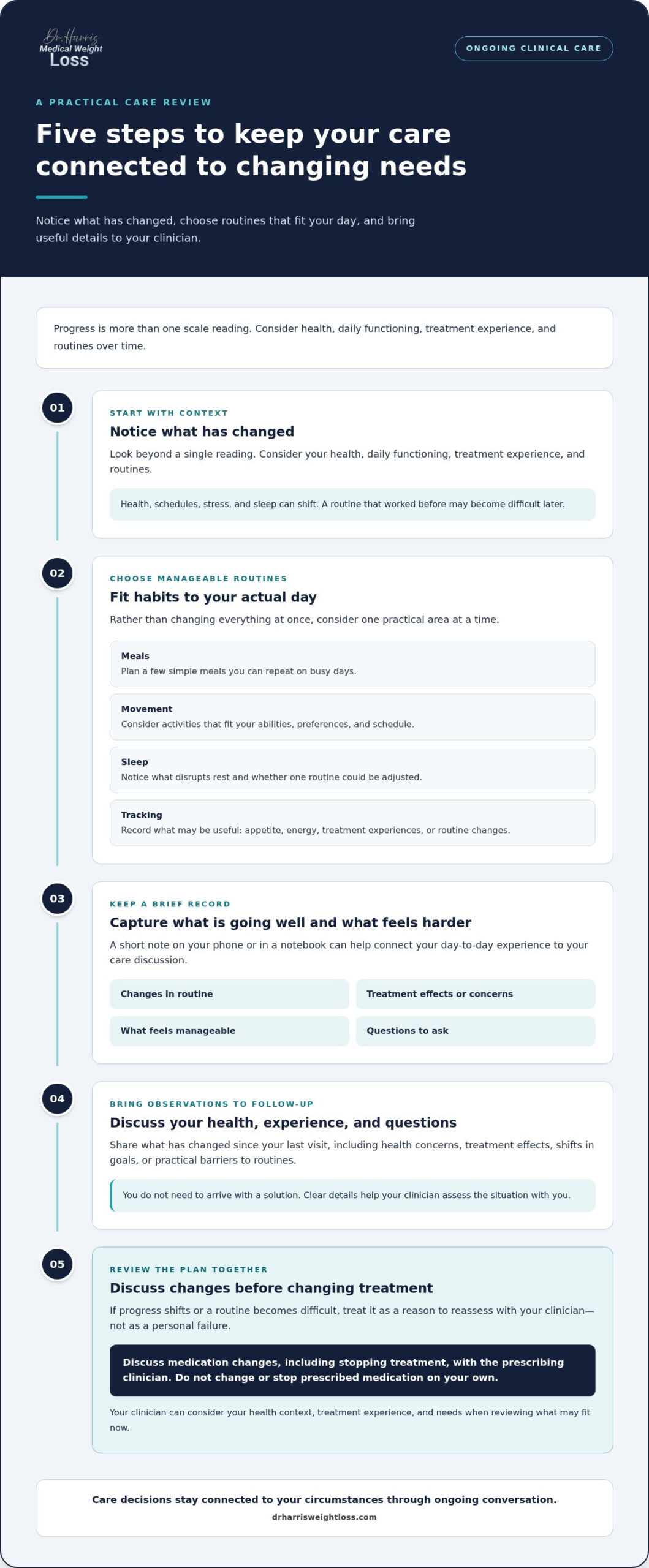
Routines work best when they fit your actual day, not an idealized schedule. Rather than changing everything at once, consider which steps feel manageable:
- Meals: Which simple meal choices help you stay consistent, including on busy days? For example, plan a few meals you can repeat when your schedule is full.
- Movement: What kinds of activity fit your abilities, preferences, and schedule?
- Sleep: What tends to disrupt your rest, and is there one routine you could adjust?
- Tracking: What would be useful to record, such as appetite, energy, treatment experiences, or changes in routine?
There’s no single template that suits everyone. Use these prompts to identify habits you can discuss and adapt with your clinician as circumstances shift. A short note about what you managed on a typical day can be more useful than trying to track everything.
How can you respond when routines or progress change?
Start with curiosity, not self-blame. If progress plateaus or a routine becomes difficult, note what changed: a new work schedule, disrupted sleep, stress, or a treatment concern. Bring those observations to follow-up. You and your clinician can consider practical adjustments and whether your treatment plan needs review. Don’t change or stop prescribed medication without discussing it with the prescribing clinician.
Keep a brief note on your phone or in a notebook: what’s going well, what feels harder, any treatment effects, and questions you want answered. Study findings describe the participants and conditions examined; they don’t establish that the same approach or outcome applies to every person. Your notes help connect general information to your own experience and support long term success with medical weight loss without turning any one routine into a rule.
Dr. Harris Medical Weight Loss provides medically supervised programs featuring Tirzepatide (Zepbound) and Semaglutide, with clinical evaluation and follow-up. Explore Dr. Harris Medical Weight Loss.
Keeping Medical Weight Loss on Track with Clinician Guidance
A treatment review turns your experience into information that can guide the next step. To make the conversation useful, discuss progress, health context, treatment experience, and questions. Share changes in your health, concerns about medication, shifts in your goals, or practical barriers that make routines harder to maintain.
What should you discuss at a treatment review?
Bring notes about what’s changed since your last visit and what you’d like help with. You might mention a new health concern, a treatment effect, difficulty following your usual routine, or questions about whether your current approach still fits. You don’t need to have a solution ready. Clear details help your clinician assess the situation with you.
Medication changes, including stopping treatment, should be discussed with the prescribing clinician rather than made on your own. Individual treatment decisions require clinical assessment of a person’s health context, treatment experience, and needs; general information can’t determine the right course for everyone.
If you’re exploring treatment with tirzepatide, learn more about the Tirzepatide program in Fort Lauderdale. Dr. Harris Medical Weight Loss serves Fort Lauderdale, Boca Raton, Broward County, and Palm Beach County, with medical evaluation and oversight. For long term success with medical weight loss, ongoing conversations can help keep treatment decisions connected to your changing circumstances. Explore Dr. Harris Medical Weight Loss.
Keep Your Care Moving Forward
Progress over time is best understood in context, not through a single number. Regular clinical conversations help connect your health, treatment experience, and daily routines, while practical habits can be reviewed and adjusted as life changes. If progress shifts or a routine becomes difficult, treat it as a reason to reassess with your clinician, not as a personal failure.
That partnership is central to long term success with medical weight loss. Discuss medication changes or stopping treatment with the prescribing clinician, who can consider your individual circumstances and help you understand the options.
Dr. Harris Medical Weight Loss is a medically supervised practice serving Fort Lauderdale, Boca Raton, Broward County, and Palm Beach County. Take the next step by exploring medical weight management with Dr. Harris.
Frequently Asked Questions
Can medical weight loss support long-term success?
Medical care can support long term success with medical weight loss by providing assessment, follow-up, and a place to discuss treatment and routines over time. Individual experiences vary, and no program can promise a specific outcome. A useful next step is to review your health context, progress, and questions with the clinician overseeing your care.
What happens if I stop medication prescribed for weight management?
The effects of stopping medication vary by person and treatment. Don’t change or stop a prescription without discussing it with the clinician who prescribed it. A review can take your health history, current progress, treatment experience, and concerns into account. You can also discuss options for continued care and what to monitor if your treatment plan changes.
How can I maintain progress during medical weight management?
Build routines that fit your circumstances, then review them when those circumstances change. Keep notes on progress, treatment experience, and barriers, such as a schedule change that disrupts meal planning or movement. Bring these details to follow-up so your clinician can help put them in context. Dr. Harris Medical Weight Loss serves patients in Fort Lauderdale, Boca Raton, Broward County, and Palm Beach County.
Does medication alone ensure long-term success?
No medication can guarantee an individual result. Medication is one part of care; clinical follow-up and daily routines can also play a role. Ask the clinician responsible for your treatment about the expected role of your prescription, concerns to watch for, and how your care will be reviewed. Share changes in your health or treatment experience so decisions reflect your situation.