
If you searched for “lipotropic injections benefits and risks,” the most useful starting point is to look closely at what a claim actually says and what evidence supports it. Online descriptions can make benefits sound straightforward while leaving important questions about side effects and personal suitability unanswered. Before considering any treatment, it helps to separate broad promises from information specific to a product and your health.
This guide explains how to assess treatment claims, prepare for a clinical conversation, and understand why safety decisions depend on the specific medication and the person. It also describes Dr. Harris Medical Weight Loss’s supervised semaglutide and tirzepatide programs. If you live in Fort Lauderdale, Boca Raton, Broward County, or Palm Beach County, these steps can help you prepare for a discussion about your care.
Lipotropic injections benefits and risks: how to evaluate a claim
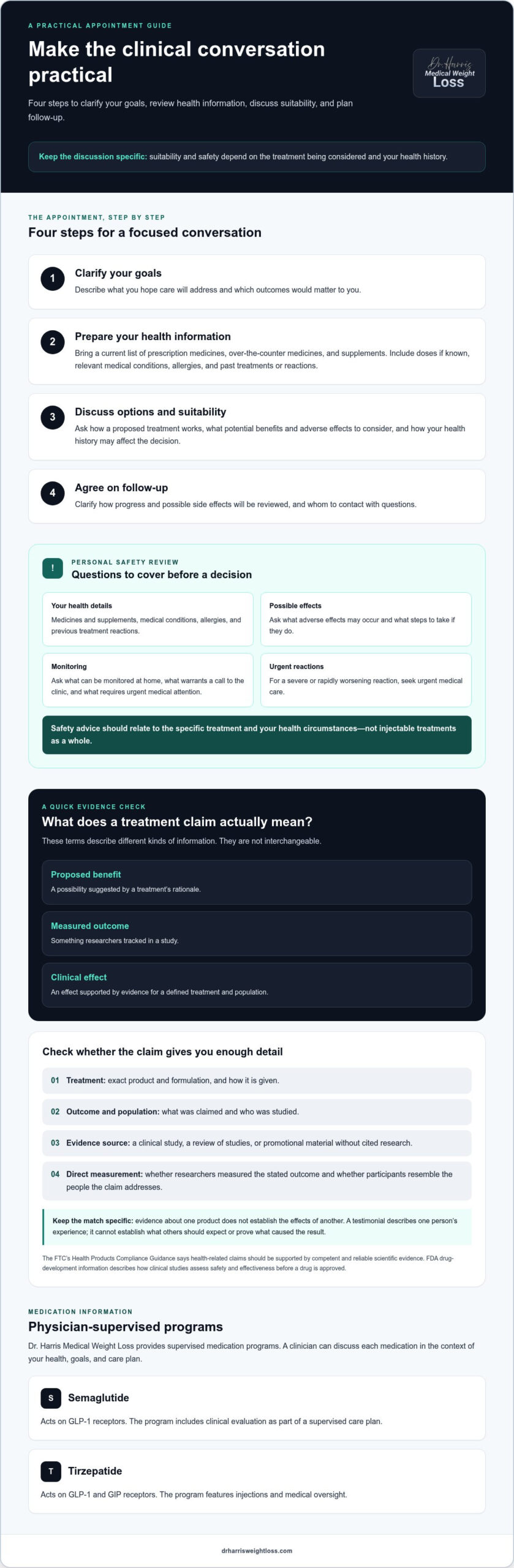
A proposed benefit is a possibility suggested by a treatment’s rationale. A measured outcome is something researchers tracked in a study. A clinical effect is supported by evidence for a defined treatment and population. These categories aren’t interchangeable. Evidence about one product cannot establish the effects of another, even when their marketing uses similar language.
Evidence-based treatment claims are tied to reliable research on the specific treatment, outcome, and population being discussed. The Federal Trade Commission’s Health Products Compliance Guidance explains that health-related claims should be supported by competent and reliable scientific evidence. FDA drug-development information also describes how clinical studies assess safety and effectiveness before a drug is approved. These standards provide context, but the evidence still needs to match the claim.
What makes a benefit claim credible?
Get specific. Identify the treatment and formulation, how it is given, the outcome being claimed, and the people studied. Then look at the source: Is it a clinical study, a review of multiple studies, or promotional material that does not cite research? Check whether researchers measured the outcome directly and whether the participants resemble the people the claim addresses.
A testimonial can describe one person’s experience, but it cannot show what others should expect or prove that the treatment caused the result. Broad phrases such as “supports wellness” are difficult to evaluate unless they define a measurable outcome. Assess claims against research on the particular treatment and outcome, not general statements about injections.
If a claim leaves out the treatment details, study population, or evidence source, don’t assume it applies to you. A clinician can help put available evidence in the context of your health and goals.
Key Takeaways
- Separate a proposed benefit from a measured outcome and a clinical effect. Evidence applies to a specific treatment and population, not to injectable treatments as a whole.
- Before considering treatment, prepare to discuss your medications, health conditions, goals, possible adverse effects, and how monitoring may work.
- Make the clinical conversation practical: clarify your goals, share relevant health information, discuss options, and agree on follow-up.
- Dr. Harris Medical Weight Loss provides physician-supervised medication programs featuring semaglutide and tirzepatide. Semaglutide acts on GLP-1 receptors; tirzepatide acts on GLP-1 and GIP receptors.
How to assess claims about injectable treatments
When evaluating a treatment claim, check whether it identifies the exact product, the outcome, and the people for whom that outcome was assessed. Then consider whether the source provides evidence or relies mainly on testimonials and promotional wording. A claim about one product should not be treated as evidence for a different medication.
Keep a note of what you want to know, such as what the treatment is intended to do, what evidence supports that purpose, and what risks are relevant to you. This makes it easier to distinguish information about a treatment from statements that are too broad to guide a personal decision.
Which safety questions matter before considering an injectable treatment?
There isn’t one safety profile for all injectable treatments. Potential risks depend on the specific medication or product, how it is used, and personal health factors. An effect reported for one treatment should not automatically be assumed to apply to another.
Safety depends on the treatment being considered and the person’s health history, so suitability and monitoring should be assessed individually. Before making a decision, discuss:
- Current prescription medicines, over-the-counter medicines, and supplements
- Relevant medical conditions, allergies, and previous reactions to treatment
- Your goals and the outcomes that would matter to you
- Possible adverse effects and what steps to take if they occur
- How follow-up and monitoring would be handled
What should a clinician review before treatment?
A clinician can use your medical history and medication list to identify factors that may affect whether a particular option is appropriate. Bring an up-to-date list of what you take, including doses if known, and mention any previous treatment reactions. FDA prescribing information outlines warnings and adverse reactions for individual medications, which is why safety advice should relate to the specific treatment rather than injectable products in general.
Ask which symptoms can be monitored at home, which should prompt a call to the clinic, and which require urgent medical attention. The answer may depend on the treatment and your health circumstances. If you experience a severe or rapidly worsening reaction, seek urgent medical care.
A careful assessment makes room for questions before treatment begins. Dr. Harris Medical Weight Loss provides physician-supervised medication programs where you can discuss health factors, treatment goals, and follow-up with a clinician.
How to discuss medically supervised options with a clinician
A useful appointment is a two-way conversation, not a commitment to begin treatment. Start with what you hope to address, then review your health information, possible options, and a follow-up plan with the clinician.
- Clarify your goals. Describe what you’d like care to address and which outcomes would matter to you.
- Prepare your health information. Bring a current medication and supplement list, relevant medical history, allergies, and details of past treatments or reactions.
- Discuss options and suitability. Ask how a proposed treatment works, what potential benefits and adverse effects to consider, and how your health history may affect the decision.
- Agree on follow-up. Before leaving, clarify how progress and possible side effects will be reviewed and whom to contact with questions.
Dr. Harris Medical Weight Loss provides physician-supervised programs featuring semaglutide and tirzepatide. The semaglutide program includes clinical evaluation as part of a supervised care plan. The tirzepatide program features injections and medical oversight. A clinician can discuss each medication in the context of your health, goals, and care plan.
What information should you bring to an appointment?
Write down questions as they come up, especially about monitoring, follow-up, and symptoms that may need medical attention. If you’ve tried a treatment before, note what you took and how you responded. This helps the clinician understand your experience and tailor the discussion to you instead of relying on general claims.
Dr. Harris Medical Weight Loss provides physician-led care in Fort Lauderdale and serves patients in Boca Raton, Broward County, and Palm Beach County. To discuss your goals and health history with a clinician, explore the physician-supervised care program.
Take the Next Step With a Clinician
Questions about an injectable treatment deserve a conversation grounded in your health, priorities, and the evidence for the specific option being considered. You don’t need to decide before that discussion. A clinical assessment can help you understand whether a treatment fits your needs and what follow-up may involve.
Dr. Harris Medical Weight Loss is physician-owned and operated by Dr. Jacob Harris, MD. The clinic is a LegitScript-certified dispensing office. If you’re in Fort Lauderdale, Boca Raton, Broward County, or Palm Beach County and are ready to discuss care with a clinician, explore physician-supervised care with Dr. Harris Medical Weight Loss.
Bring your questions and share your health history openly. A clear, individualized discussion is a practical first step toward making an informed choice.
Frequently Asked Questions
Are injectable treatments appropriate for everyone?
No. Suitability depends on the specific treatment and a person’s health circumstances, so a general claim or another person’s experience can’t determine whether it’s right for you. A new diagnosis or medication since a previous assessment may change the discussion. Share updates with your clinician before starting or continuing treatment, and don’t adjust a prescribed medication without medical guidance.
What risks should I ask a clinician about?
Ask about potential adverse effects of the specific treatment, how they may affect daily activities, and what to do if they occur. You can also ask whether the treatment may interact with your medicines or supplements, what to do if you miss a dose, and how to report a new symptom. Request clear instructions you can refer to after the appointment.
How can I tell whether a benefit claim is supported by evidence?
Look for a claim tied to a defined outcome and a source that explains how the outcome was assessed. For example, a statement about appetite should be supported by evidence that measured appetite, not just a general wellness testimonial. Check whether the source identifies the treatment studied and its participants, and be cautious if an advertisement offers certainty without explaining its basis.
Can injectable treatment be part of a physician-supervised program?
Yes. A clinician may include an injectable medication in a broader care plan when it is suitable for the individual, with decisions and follow-up guided by clinical assessment. Dr. Harris Medical Weight Loss provides physician-supervised programs featuring semaglutide and tirzepatide. People in Fort Lauderdale, Boca Raton, Broward County, and Palm Beach County can explore the clinic’s care options.