
An ingredient list may sound reassuring, but it does not show that a treatment will help with weight management. If you’re asking whether lipotropic injections are worth it, it’s reasonable to look for evidence before deciding whether they belong in your care.
Lipotropic injections are often promoted for their ingredients, but an intended role is not proof of weight-loss benefits. Consider what evidence supports the ingredients, what a treatment is meant to do, and how your health history, medications, and goals affect the decision. A healthcare professional can help you weigh these factors as part of your broader health plan, without promising a particular result.
Key Takeaways
- Assess treatment claims by separating what an ingredient is intended to do from what clinical evidence supports.
- Discuss your health history, medications, goals, and energy concerns with a healthcare professional before choosing a treatment.
- Learn how vitamins, amino acids, and inositol may fit into a broader conversation about nutrition and weight management.
- Explore the Semaglutide Medication Program, Tirzepatide (Zepbound) Program, and Phentermine Medication as distinct options to discuss with a clinician.
Choosing a Weight Management Treatment With a Healthcare Professional
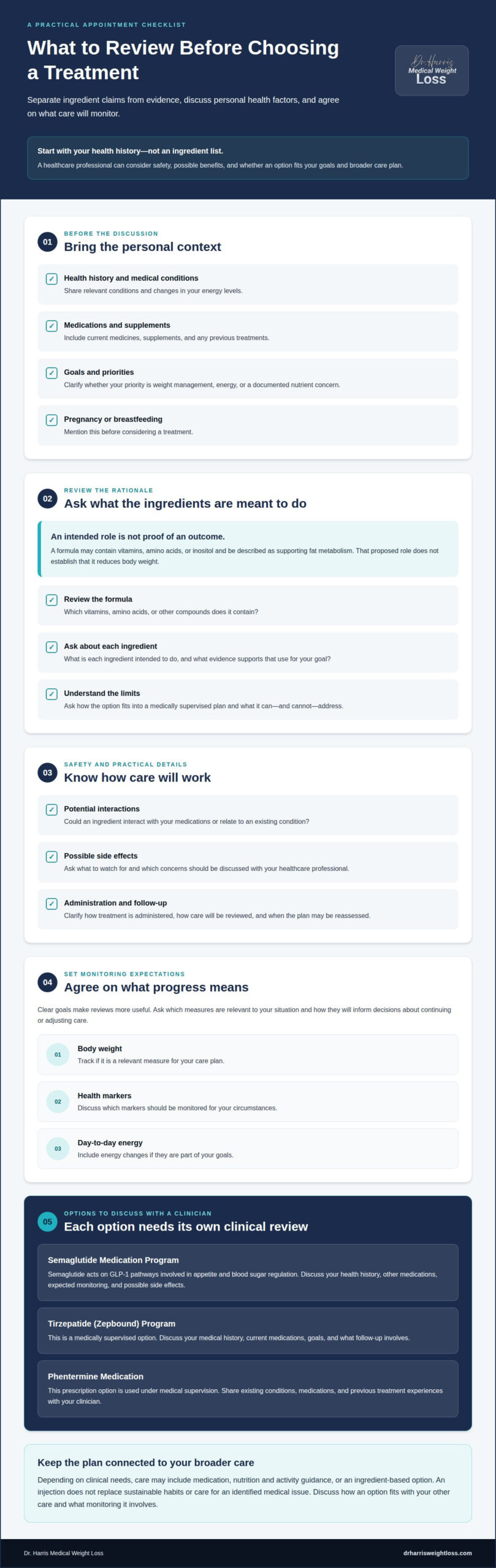
A treatment discussion should begin with your health history, not an ingredient list. At a clinic, explain your weight management goals, current medications, medical conditions, and changes in energy levels. Mention supplements and previous treatments, too. These details help a healthcare professional consider safety, possible benefits, and whether an option fits your needs. If you’re assessing an ingredient-based approach, ask what evidence supports its use for your specific goal.
Ask what each ingredient is intended to do and what evidence supports that use. Lipotropic formulas may contain vitamins, amino acids, or inositol. They may be described as supporting fat metabolism, but that proposed role does not establish that they reduce body weight. Ask how the treatment fits into a medically supervised plan and which outcomes will be monitored. Distinguishing an ingredient’s intended function from demonstrated results can help you judge its relevance to your care.
Make the discussion practical by asking how the ingredients were selected, what side effects to watch for, and how your medications or health conditions affect the plan. If pregnancy or breastfeeding applies, mention it before considering treatment. Ask how the injections are administered and how your care will be reviewed over time. These details clarify what the process and follow-up involve.
- Clarify the goal: Is the priority weight management, energy levels, or addressing a documented nutrient concern?
- Review the formula: Which vitamins, amino acids, or other compounds does it contain, and what is each intended to do?
- Discuss safety: Could an ingredient interact with your medications or relate to an existing condition?
- Set monitoring expectations: What changes will be tracked, and when will the treatment plan be reassessed?
These questions help distinguish an ingredient’s rationale from measurable outcomes. A formula may be described as supporting fat metabolism, while a program tracks body weight, health markers, or day-to-day energy. Ask which measures are relevant to your situation and how they will inform decisions about continuing or adjusting care. Clear goals make progress reviews more useful.
A clinic provides medical oversight, explains treatment choices, and considers the broader care plan. Depending on clinical needs, that plan may include medication, nutrition and activity guidance, or an ingredient-based option. An injection does not replace sustainable habits or care for an identified medical issue. For those also exploring non-invasive body shaping alongside broader wellness goals, resources such as contourbodyimaging.com discuss what targeted aesthetic treatments can realistically achieve. Before deciding, ask how the option fits with your other care, what its limits are, and what monitoring it involves. Keep the discussion grounded in your health history and goals.
Dr. Harris Medical Weight Loss Programs
Dr. Harris Medical Weight Loss offers medically supervised medication programs for people considering support with weight management. If you’re weighing treatment options, the practice can help you understand which available program may fit your health history and goals. A clinical discussion can also clarify what each option involves and how it fits into care.
The Tirzepatide (Zepbound) Program is a medically supervised weight-management option. When discussing whether it may suit you, a healthcare professional can review your medical history, current medications, and goals. Ask how the medication is supervised and what follow-up involves. These details clarify its role in an ongoing care plan.
The Semaglutide Medication Program is another option available through the practice. Semaglutide acts on GLP-1 pathways involved in appetite and blood sugar regulation. Its role in a treatment plan depends on clinical considerations, including your health history and other medications. Discuss expected monitoring and possible side effects with a healthcare professional before deciding whether this option fits your needs.
Phentermine Medication is another prescription option, used under medical supervision to support weight-reduction goals. A clinician can consider relevant health factors and discuss how it may fit with your care. Share existing conditions, medications, and previous treatment experiences so the discussion reflects your circumstances. No single option is right for everyone.
These are distinct treatment options, not interchangeable promises. Medical supervision gives you a chance to discuss a medication’s purpose, how progress will be reviewed, and whether the plan may need adjustment. It keeps the focus on your health goals rather than on a product alone. Questions about energy, appetite, and previous treatment experiences can make the conversation more useful.
Before choosing, consider what you want help with and what matters in your daily life. You may want to discuss appetite, routines, health conditions, or how treatment could work alongside nutrition and physical activity. Raise concerns directly, including uncertainty about medication or the commitment involved. Clear communication helps your healthcare professional understand your priorities and explain options without pressure.
Dr. Harris Medical Weight Loss provides a setting to discuss medication options with medical oversight. The next step is a conversation about your health background, goals, and the treatment approaches that may suit your needs. Contact Dr. Harris Medical Weight Loss to discuss your options.
Frequently Asked Questions
What Injectable Treatments May Be Used for Weight Management?
Medically supervised programs may include prescription injectable medications such as Semaglutide or Tirzepatide. These are distinct treatment options; a clinician considers your health history, medications, and goals when discussing them. Clinical practices like injectionsandco.com illustrate how individualized evaluations and monitoring are applied in medical weight loss. The appropriate choice depends on individual medical factors, so ask what monitoring is involved and how the medication fits into ongoing care. Medications are dispensed by licensed pharmacies and provided safely under physician supervision.
Are Injectable Treatments Worth Considering?
Prescription injections may be worth discussing when a clinician is evaluating medication as part of weight-management care. The decision depends on the specific medication, your health circumstances, and its potential benefits and risks. Before deciding, ask what the treatment is intended to address, how progress will be assessed, and what follow-up involves. Individual results vary, and outcomes depend on genetics, lifestyle, adherence, and medical guidance.
What Do Injectable Medications Contain?
Prescription injectable medications contain an active drug formulated for administration by injection. The active ingredient and its effects depend on the medication. Semaglutide is a prescription medication. Tirzepatide is a prescription medication. A clinician or pharmacist can explain the medication being considered, its intended use, and relevant handling instructions. Medications are dispensed by licensed pharmacies and provided safely under physician supervision.
Do Injectable Medications Help With Weight Loss, and What Does Evidence Show?
Evidence and expected effects depend on the specific medication, not simply on its being given by injection. Semaglutide and Tirzepatide are prescription options used within medically supervised care. A clinician can explain the evidence relevant to the medication under consideration, how it relates to your health history, and what monitoring may be appropriate during treatment. Individual results vary, and outcomes depend on genetics, lifestyle, adherence, and medical guidance.
How Much Weight Loss Can People Expect From Injectable Medication?
There is no single result that applies to everyone taking injectable medication. Individual results vary, and outcomes depend on genetics, lifestyle, adherence, and medical guidance. Your clinician can explain how progress will be assessed, including which health measures matter beyond body weight. Do not treat another person’s experience as a forecast of your own.