
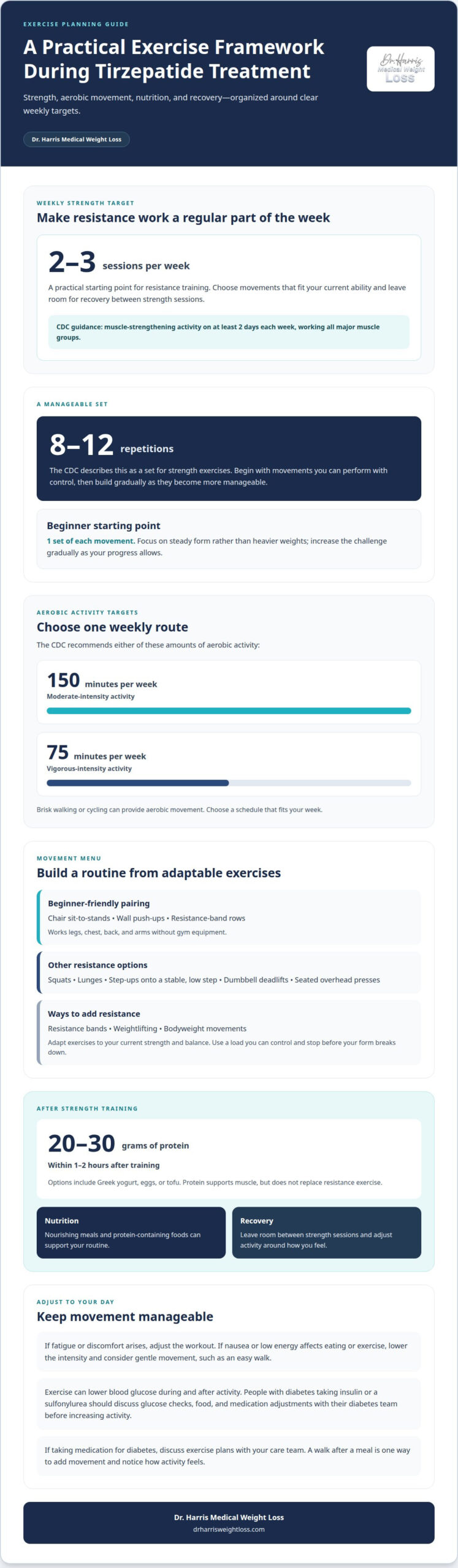
Strength work belongs alongside tirzepatide treatment, not on the sidelines. A practical starting point for exercise recommendations while on tirzepatide is resistance training two to three times per week, using movements such as squats, rows, and wall push-ups that suit your current ability. The CDC recommends muscle-strengthening activity at least two days each week, working all major muscle groups.
It’s understandable to wonder whether exercise is safe or worthwhile while your appetite and energy are changing. Regular activity can help maintain strength and function, and exercise can support the broader goals of GLP-1 treatment. It should complement your medication, not become a test of willpower. This article explains how to build a manageable strength routine, which exercises to try, and how nutrition and recovery can support muscle. It also covers how aerobic movement may contribute to your overall health and how to adapt activity around how you feel.
Key Takeaways
- Build toward strength training two to three times per week, choosing movements that work major muscle groups and suit your current ability.
- Use a manageable starting point: the Centers for Disease Control and Prevention describes 8 to 12 repetitions as a set for strength exercises.
- Support muscle retention with resistance exercise, nourishing meals, hydration, and enough recovery as your routine develops.
- Pair strength work with aerobic activity to support overall fitness and learn how exercise may benefit you during GLP-1 treatment.
1. Strength training frequency and exercise examples
A practical approach to exercise recommendations while on tirzepatide is strength training two to three times a week. Options include resistance bands, weightlifting, and bodyweight movements such as squats, lunges, and push-ups. These exercises work major muscle groups and can be adapted to your current strength and balance.
The Centers for Disease Control and Prevention recommends muscle-strengthening activity on at least two days each week, working all major muscle groups. It describes 8 to 12 repetitions as a set for strength exercises. Begin with movements you can perform with control, then gradually build your routine as they become more manageable.
For a beginner-friendly workout, pair chair sit-to-stands with wall push-ups and resistance-band rows. These exercises work your legs, chest, back, and arms without gym equipment. Start with one set of each movement, focusing on steady form rather than heavier weights. Increase the challenge gradually as your progress allows.
Strength workouts complement aerobic activity. The CDC recommends 150 minutes of moderate-intensity physical activity weekly, or 75 minutes of vigorous-intensity activity. Brisk walking or cycling can provide aerobic movement, while resistance exercises build strength. Choose a schedule that leaves room for recovery between strength sessions.
After strength training, aim for 20 to 30 grams of protein within one to two hours. Greek yogurt, eggs, or tofu are practical options. Protein supports muscle, but it doesn’t replace resistance exercise. Pairing both can help support muscle retention. Use these exercise recommendations while on tirzepatide as a framework, adjusting workouts if fatigue or discomfort arises.
2. How Can Muscle Loss Be Prevented During Weight Loss on Tirzepatide?
Changes in body weight can involve both fat and lean mass. In a tirzepatide body-composition substudy, researchers scanned 160 participants; about 75% of weight lost was fat and 25% was lean mass. These findings show why preserving muscle can be part of a broader treatment plan.
Resistance training challenges your muscles as your body composition changes. For variety, try step-ups onto a stable, low step, dumbbell deadlifts, or seated overhead presses. Begin with a load you can control, and stop each set before your form breaks down. Increase resistance gradually rather than raising the weight and repetitions at the same time. Adequate protein and recovery support your training.
How can exercise help preserve muscle during weight loss on tirzepatide? Repeated resistance challenges help maintain muscle function, while protein provides material for repair. Consistency matters more than complicated exercises. A short session with controlled movements may be easier to sustain.
How much aerobic exercise should adults on tirzepatide aim for each week? Work toward the aerobic activity target described earlier in this article. Walking, cycling, or dancing can help you reach it. Choose an activity that fits your usual week.
People with diabetes taking insulin or a sulfonylurea should discuss glucose checks, food, and medication adjustments with their diabetes team before increasing activity. For treatment-related questions, the Tirzepatide (Zepbound) Program can be part of a conversation about your care.
3. Benefits of exercising while taking GLP-1 medications
Exercise can complement medication by supporting physical function as appetite and eating patterns change. Its practical benefits go beyond the scale: walking, cycling, and resistance training can make regular movement part of everyday life. Choose activities you can repeat instead of treating every workout as a test of intensity.
Blood glucose is another important consideration. Exercise can lower blood glucose during and after activity. A walk after a meal, for example, adds movement to your day and lets you notice how activity feels. If you take medication for diabetes, discuss exercise plans with your care team, especially if your treatment includes insulin or a sulfonylurea.
Appetite changes can make consistent nutrition harder. Plan meals and snacks around activity when needed, and include protein-containing foods such as eggs, beans, or yogurt. If nausea or low energy affects eating or exercise, lower the intensity and choose gentle movement, such as an easy walk, rather than forcing a demanding session.
Regular activity can help you build a routine you can repeat. Start with a short walk, then add time or another session as it feels manageable. Moderate movement should feel purposeful while still allowing you to talk. Walking and strength work support different aspects of fitness, while rest between challenging sessions gives your body time to recover.
The takeaway is simple: movement complements GLP-1 treatment, while medication doesn’t replace activity, nutrition, or recovery. If you’d like help connecting treatment with your health goals, explore treatment support.
Dr. Harris Medical Weight Loss: Tirzepatide (Zepbound) Program
Dr. Harris Medical Weight Loss offers a Tirzepatide (Zepbound) Program for people considering medication as part of weight management. Tirzepatide complements habits such as strength training, regular movement, and nutrition; it does not replace them. If you are weighing treatment options or want medical guidance about medication, the program offers a way to discuss whether tirzepatide fits your health needs.
Exercise routines should reflect your current fitness, symptoms, and health considerations. Bring questions about activity, appetite changes, or nutrition to a treatment discussion so these factors can be considered together. Contact Dr. Harris Medical Weight Loss to discuss the Tirzepatide (Zepbound) Program.
Make your next step sustainable
Your exercise plan can evolve as your energy, appetite, and daily routine change. Keep your exercise recommendations while on tirzepatide flexible enough to support consistency, and discuss adjustments with your healthcare provider when your needs or symptoms change. The aim is to build habits that fit your life, not to push through discomfort or judge progress by a single outcome.
Medication is one part of a broader care decision. Dr. Harris Medical Weight Loss offers a Tirzepatide (Zepbound) Program, a Semaglutide Medication Program, and Phentermine Medication. You can learn about each program and discuss your next steps with your healthcare provider.
Contact Dr. Harris Medical Weight Loss to discuss your options. Steady, thoughtful choices can help you keep moving toward strength and well-being.
Frequently Asked Questions
Exercise While Taking GLP-1 Medications: What’s Safe?
For many people, a comfortable activity is a sensible place to start. Use the talk test for moderate movement: you should be able to talk, but not sing. A level walking route or stationary bike can make it easier to control your effort. Stop exercising if you feel dizzy or faint, and seek urgent help for chest pain, fainting, or unusual shortness of breath.
How Should Exercise Be Adapted When Using Tirzepatide?
Match workout timing to how you feel and when nausea is least disruptive. A small meal about one to two hours before exercise, or a light snack 60 to 90 minutes beforehand, may help provide energy. If eating is difficult, avoid forcing a demanding session; choose a time and activity that feel manageable.
Can I exercise on my GLP-1 injection day?
There’s no strict clinical rule requiring you to avoid exercise on injection day. People using a weekly GLP-1 injection don’t need to rest after every shot if they feel well and their clinician hasn’t restricted activity. Notice how you feel after the dose and let that guide whether you keep your planned workout or choose a gentler option.
How Can Muscle Loss Be Prevented During Weight Loss on Tirzepatide?
Track more than scale weight: note whether everyday tasks, such as carrying groceries or rising from a chair, feel easier or harder. Changes in strength can help you recognize when your routine or nourishment may need attention. If your strength declines or eating becomes difficult, discuss these changes with your healthcare professional so your plan can be reviewed.
How often should people taking tirzepatide do strength training?
A practical target is two to three strength sessions each week. Space them across the week instead of clustering them together, and allow time to recover before challenging the same muscle groups again. For example, you might train on Monday and Thursday, adding another session only if your schedule and recovery allow. Consistency can make the routine easier to maintain.