The key difference in Zepbound versus compounded tirzepatide safety is that Zepbound is FDA-approved, while compounded tirzepatide is not. According to the U.S. Food and Drug Administration (FDA), compounded drugs aren’t reviewed for safety, effectiveness, or quality before they reach patients. That distinction matters when considering medication quality and ingredient integrity.
It’s understandable to want clear answers before choosing a treatment. This guide explains how the medications differ, what FDA approval does and doesn’t establish, and why preparation and handling matter. You’ll find practical points to discuss with your clinician as you weigh safety and quality.
Key Takeaways
- Learn why dosing accuracy matters and how dosing errors can affect side effects and treatment experience.
- Understand how preparation, storage, and ingredient form can influence compounded medication quality.
- See how approved uses and rules for compounding shape the differences between these medication options.
- Find out what to discuss with a clinician when considering Zepbound as part of a medically supervised treatment plan.
What’s the difference between Zepbound® and compounded tirzepatide?
Zepbound is FDA-approved; compounded tirzepatide is prepared by compounding pharmacies and is not FDA-approved. When comparing Zepbound vs. compounded tirzepatide safety, key differences include dosing format, regulatory review, and how each medication is prepared.
Dosing Consistency and Side-Effect Risks
Zepbound’s single-use pens provide set doses, while compounded versions may require measuring medication from a vial. Measuring adds a step where dosing errors can occur. Tirzepatide acts on GIP and GLP-1 pathways, and an incorrect dose may cause severe side effects lasting up to a few weeks. Insurance or manufacturer savings-program eligibility depends on the plan and program rules, including coverage terms.
Reported Adverse Events
FDA adverse-event reports involving compounded products are safety signals, but reports alone do not establish that a medication caused every event or measure an individual patient’s risk. When considering Zepbound vs. compounded tirzepatide safety, weigh differences in product oversight and dosing methods rather than treating reports as proof that every compounded dose is unsafe.
Compounded Tirzepatide Preparation
Compounding pharmacies prepare medication for an individual prescription. Under U.S. federal law, Section 503A pharmacies fill individual prescriptions; Section 503B outsourcing facilities can produce larger quantities under more stringent oversight. After the shortage was resolved, a doctor may determine that brand-name medication can’t meet a patient’s specific medical needs. Cost varies with insurance coverage, manufacturer program eligibility, and the medication’s formulation; no single amount applies to everyone.
| Option | FDA approval | Dose format |
|---|---|---|
| Zepbound | Approved | Single-use pens |
| Compounded tirzepatide | Not approved | May require measuring a dose |
Choose with a clinician, weighing approved uses, dosing method, coverage, and your medical needs.
Compounded medication quality and ingredient integrity
Compounding can tailor a medication to an individual prescription, but it doesn’t establish that the finished product matches an FDA-approved drug. The U.S. Food and Drug Administration (FDA) says compounded drugs aren’t reviewed for safety, effectiveness, or quality before reaching patients. For weight management, that makes ingredient identity, preparation, and testing important parts of the safety picture.
Ingredient form matters. The FDA has warned about some compounded products made with active pharmaceutical ingredients not approved for compounding, including semaglutide salts. A certificate of analysis for the active ingredient and independent testing of the finished medication can provide information about potency, stability, and sterility. These records address different quality questions, and neither alone establishes every aspect of product quality.
You can review a compounding pharmacy’s state license and check its state licensing board for complaints or disciplinary actions. Pharmacy Compounding Accreditation Board accreditation is an optional third-party credential, not a substitute for state licensure. Ask whether the medication uses the appropriate base form rather than a salt form, and whether finished-product testing covers potency, stability, and sterility. These steps help clarify how ingredient integrity and quality controls are addressed.
Zepbound is FDA-approved for chronic weight management in eligible adults and for moderate-to-severe obstructive sleep apnea. The right option depends on your medical needs, potential side effects, and insurance coverage rules. An approved medication has undergone FDA review; compounded products follow a different quality pathway, so their evidence and oversight are not interchangeable. A clinician can use these distinctions to guide a discussion about treatment and weight management.
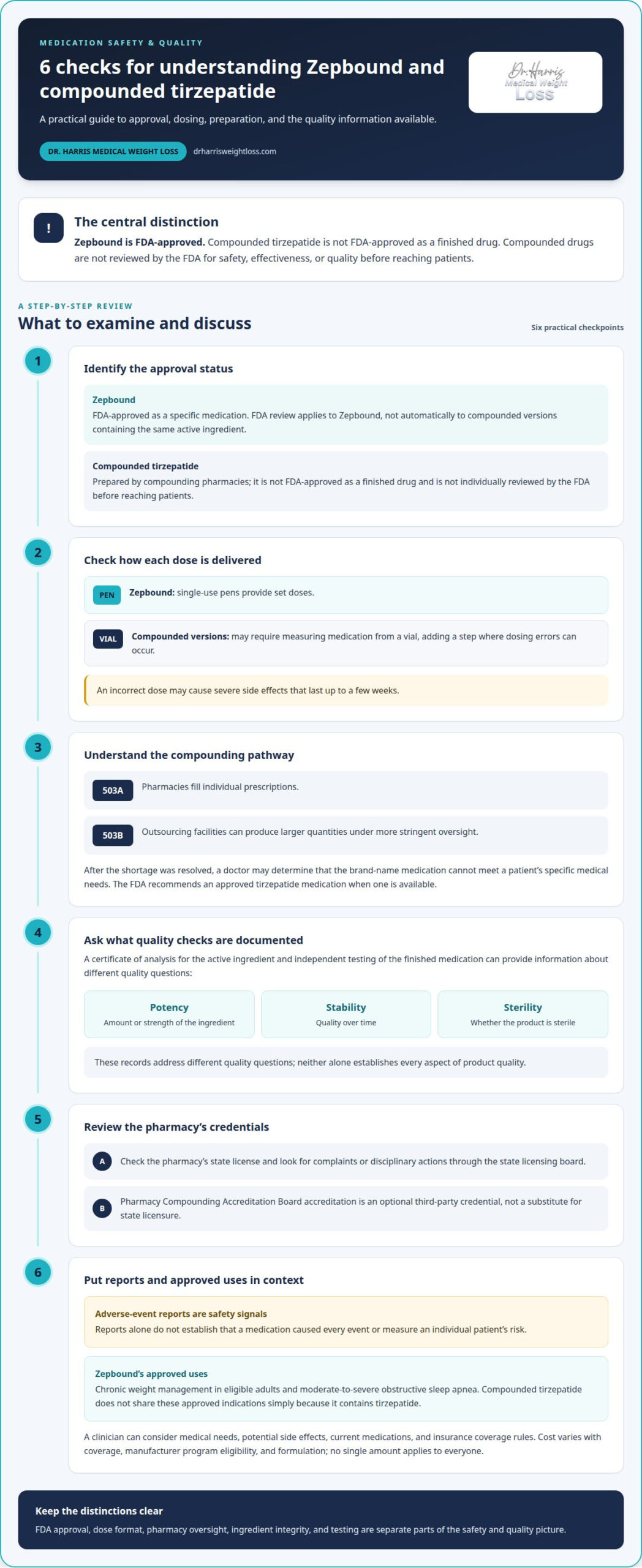
Differences between compounded tirzepatide and FDA-approved Zepbound
Zepbound is FDA-approved for specific uses; compounded tirzepatide is not approved as a finished drug. That distinction affects approved indications and the evidence available to assess effectiveness.
FDA Approval and Regulation
Compounding pharmacies prepare medication to meet an individual prescription, but compounded tirzepatide is not an FDA-approved product. FDA approval applies to Zepbound as a specific medication, not automatically to compounded versions containing the same active ingredient. After the shortage was resolved, pharmacies may compound tirzepatide only when a doctor determines that the brand-name drug cannot meet a patient’s specific medical needs. The FDA recommends an approved tirzepatide medication when one is available.
FDA Approval and Indications
Zepbound has approved uses for weight management and sleep apnea. Those indications are supported by clinical evidence for this medication. Compounded tirzepatide doesn’t share Zepbound’s approved indications simply because it contains tirzepatide. Mounjaro, also a tirzepatide medication, has a separate approval to improve blood sugar in people with Type 2 diabetes.
Dose Accuracy and Safety Evidence
Zepbound’s single-use pen delivers a set dose, while compounded medication may require drawing a dose from a vial, creating another opportunity for measurement errors. FDA review of Zepbound includes evidence for its approved uses; compounded products are not individually reviewed by the FDA for safety, quality, or effectiveness before reaching patients. Shared peptide activity does not make their dose accuracy or safety evidence equivalent.
For a clinician-guided conversation about treatment options, explore medically supervised care.
Dr. Harris Medical Weight Loss: Tirzepatide (Zepbound) Program
Dr. Harris Medical Weight Loss offers a Tirzepatide (Zepbound) Program as part of a medically supervised weight-management plan. After reviewing how FDA-approved Zepbound differs from compounded tirzepatide, you can discuss whether treatment with tirzepatide is appropriate based on your health history, goals, and current medications.
Dr. Harris and the clinical team can review your medical history, explain the program, and discuss appropriate next steps. If you’re considering a change from compounded tirzepatide, share your current dose and treatment response so they can consider these details in planning care. Your needs, reason for treatment, and relevant health conditions all matter.
To discuss the Tirzepatide (Zepbound) Program, contact Dr. Harris Medical Weight Loss in Fort Lauderdale or Boca Raton.
Choose a next step that fits your care
Understanding Zepbound vs. compounded tirzepatide safety is a starting point, not a complete treatment decision. A discussion with Dr. Harris can focus on your health history, current medications, treatment goals, and comfort with the prescribed dosing method. Bring questions about how a medication may fit your routine and what ongoing monitoring and support involve. Clear, direct conversations can help you understand your options and take an active role in your care. Individual results vary; weight loss results can vary based on individual factors like genetics, lifestyle, and adherence to the program.
Dr. Harris Medical Weight Loss offers medically supervised medication programs, including Tirzepatide (Zepbound), Semaglutide, and Phentermine. If you’re ready to discuss which option may suit your needs, contact Dr. Harris Medical Weight Loss. A thoughtful next step can begin with a conversation.
Frequently Asked Questions
What’s tirzepatide, and what does it do?
Tirzepatide is a peptide medication that activates GIP and GLP-1 receptors. These signaling pathways affect appetite and blood-glucose regulation, which helps explain its use in different medical treatments. The active ingredient alone doesn’t determine whether a medication is appropriate; the product’s approved indication and the patient’s health needs also matter.
Are compounded drugs approved by the FDA?
No. According to the U.S. Food and Drug Administration (FDA), compounded drugs are not FDA-approved, and the agency does not review each compounded medication for safety, effectiveness, or quality before it reaches patients. Compounding pharmacies prepare medications under different circumstances than manufacturers produce approved drugs. A prescription for a compounded medication does not mean the FDA has approved that finished product.
Is your compounded semaglutide and tirzepatide safe?
Compounded semaglutide and tirzepatide are not FDA-approved products, and the FDA does not review their safety, effectiveness, or quality before they reach patients. Dr. Harris Medical Weight Loss is LegitScript Certified, but that credential relates to the business, not FDA approval of an individual medication. In Fort Lauderdale, Boca Raton, Broward County, and Palm Beach County, treatment decisions begin with medical evaluation.
The regulatory picture: What changed, and what does it mean for you?
The FDA determined that the tirzepatide shortage was resolved on Dec. 19, 2024. After the shortage was resolved, compounding is allowed only when a doctor determines that the brand-name drug can’t meet a patient’s specific medical needs. This makes the reason for prescribing compounded tirzepatide central to the decision; shortage-related access alone no longer applies.
What are the safety concerns with compounded tirzepatide?
Key concerns include dosing mistakes, product handling, and whether the active ingredient is in the appropriate form. Drawing medication from a vial can introduce measurement errors, while improper storage during shipping may compromise effectiveness. Keep the product label and dosing instructions available for clinical review, especially if your dose or medication changes.