
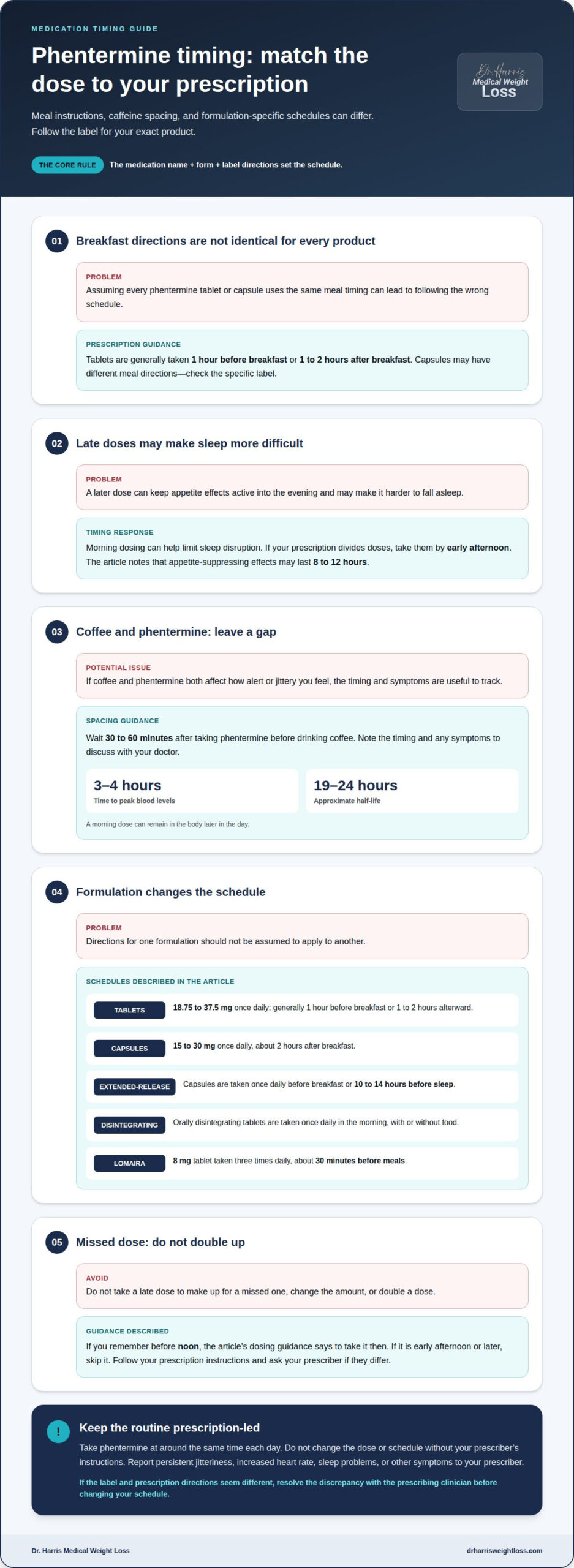
The best time of day to take phentermine is usually in the morning. Depending on the prescription, tablets are generally taken 1 hour before breakfast or 1 to 2 hours after it. Taking a dose later can make sleep more difficult, so timing it around meals and bedtime matters.
It’s understandable to want clear guidance on food, coffee, and when you might notice a difference. This article explains how to time phentermine with breakfast, why caffeine may affect how you feel, and when to take a last dose to reduce the chance of sleep problems. It also covers when changes may become noticeable, which can help you set realistic expectations while following your prescribed plan.
Key Takeaways
- Use your prescription’s meal instructions: phentermine tablets are generally taken 1 hour before breakfast or 1 to 2 hours after it.
- Morning dosing can help limit sleep disruption; if your prescription divides doses, complete them by early afternoon.
- Leave 30 to 60 minutes between taking phentermine and drinking coffee, and keep your medication timing consistent.
- Timing differs by formulation, so check whether your prescription is for immediate-release or extended-release phentermine before settling on a routine.
Timing the last dose to avoid sleep problems
FDA prescribing information and U.S. dosing guidance generally place phentermine tablets 1 hour before breakfast or 1 to 2 hours after it. Capsules can have different directions, so follow the instructions for your specific prescription.
Morning dosing helps reduce insomnia risk, while appetite-suppressing effects may last 8 to 12 hours. Phentermine can also cause jitteriness or increased heart rate; report persistent symptoms to your prescriber.
Prescribed Dose and Schedule
Your prescribed schedule sets the dose and timing for your specific phentermine formulation. Follow the label instead of changing the amount, splitting doses, or taking a late dose to make up for one you missed.
If you remember a missed dose before noon, the available dosing guidance says to take it then; if it’s early afternoon or later, skip it. Never double a dose. Dose changes may be considered for phentermine and topiramate after 14 days; after 12 weeks on a dose, a clinician assesses how much weight has changed.
Morning Dosing and Sleep
Morning dosing means taking phentermine early enough to reduce its potential effect on sleep. If you have a once-daily tablet, follow the meal timing on your prescription and avoid moving the dose toward bedtime.
If your prescription calls for split doses, take them by early afternoon to help avoid insomnia. A later dose may keep appetite effects active into the evening and make it harder to fall asleep. If sleep problems or other symptoms persist, tell your prescriber rather than adjusting your dose on your own.
Dosing Time Guidance
Dosing time guidance is the formulation-specific instruction for when to take phentermine. Tablets are generally taken 1 hour before breakfast or 1 to 2 hours afterward; capsules may have different meal directions.
Phentermine and topiramate has its own prescription schedule, which may differ from phentermine alone. Check whether your medication is a tablet or capsule and note its release type, then follow the instructions on its label. Don’t assume directions for one formulation apply to another.
How does caffeine affect phentermine timing?
Caffeine timing is the spacing between coffee and a phentermine dose. Leave 30 to 60 minutes after taking phentermine before drinking coffee. If both seem to affect how alert or jittery you feel, note the timing and symptoms to discuss with your doctor.
Peak blood levels are the point when medication concentration is highest. Phentermine reaches peak blood levels 3 to 4 hours after a dose, and its half-life is roughly 19 to 24 hours. Half-life describes how long the body takes to clear half the medication. A morning dose can therefore remain in the body later, making late-day dosing more likely to interfere with sleep.
Consistent dosing means taking phentermine at around the same time each day, across all seven days of the week. A steady routine makes it easier to notice changes in appetite, sleep, or other symptoms. Don’t adjust the schedule or dose to change the medication’s effects without your prescriber’s instructions.
Medication effects can vary with dose, formulation, timing, and individual response. For example, release capsules may have different directions from tablets, so follow the instructions for your specific prescription. Diabetes or blood pressure concerns may also affect treatment decisions, but they don’t establish one dosing time for everyone.
Medication interactions and health conditions affect whether phentermine is suitable, not simply what time to take it. Don’t use it with an MAO inhibitor or within 14 days after using one; uncontrolled high blood pressure, significant heart disease, glaucoma, and a history of drug misuse are also listed as reasons it may not be recommended. If you’re considering treatment, explore phentermine medication options as part of a clinician-guided plan.
Does the recommended timing differ for immediate-release and extended-release phentermine?
Immediate-release phentermine releases medication without an extended-release design. Extended-release phentermine is a capsule designed to release medication over time, so its timing instructions differ. Follow the directions for your exact product, not the schedule for another formulation.
For obesity treatment, phentermine tablets are directed at 18.75 to 37.5 milligrams once daily. Phentermine capsules are directed at 15 to 30 milligrams once daily, about 2 hours after breakfast. These are formulation-specific directions, not interchangeable options. Check the prescription label for the product name, form, and meal timing.
Extended-release phentermine capsules are taken once daily before breakfast or 10 to 14 hours before sleep. This longer interval matters because a dose too close to bedtime may interfere with sleep. By contrast, orally disintegrating phentermine tablets are taken once daily in the morning, with or without food.
Lomaira is a distinct 8 mg phentermine tablet taken three times daily, about 30 minutes before meals. Phentermine and topiramate extended-release capsules are a combination medication, taken once daily in the morning, with or without food. Don’t apply either schedule to phentermine alone.
Before setting a routine, match the label to the medication’s name and formulation, then follow its meal and timing instructions. If a label and your prescription directions seem different, resolve the discrepancy with the prescribing clinician before changing your schedule. Explore phentermine treatment guidance for help understanding medication options.
Dr. Harris Medical Weight Loss: Tirzepatide (Zepbound) Program
Dr. Harris Medical Weight Loss offers a medically supervised Phentermine Medication option, alongside Tirzepatide (Zepbound) and Semaglutide programs. If phentermine’s timing or effects are difficult to fit into your routine, discuss your questions with a clinician before changing your prescription or considering another treatment. These medications are distinct options, not a recommendation to switch or combine treatments. Dr. Harris Medical Weight Loss provides physician-led care in Fort Lauderdale and Boca Raton, serving Broward and Palm Beach Counties. Contact the clinic to discuss your options.
Choose a plan that fits your next steps
Knowing the best time of day to take phentermine is one part of a broader treatment plan. Your daily routine, health history, and experience with medication all matter when considering next steps. Use this information to prepare questions about your care for a qualified clinician.
Dr. Harris Medical Weight Loss offers Phentermine Medication, a Tirzepatide (Zepbound) Program, and a Semaglutide Medication Program. If you’re considering treatment or want to discuss your current plan, contact Dr. Harris Medical Weight Loss. A thoughtful conversation can help you approach your next step with greater clarity and confidence.
Frequently Asked Questions
Should you take phentermine before or after eating?
The best time of day to take phentermine depends on your prescription’s meal directions; there isn’t one rule for every product. You don’t need to fast for a day just because you take phentermine. Don’t skip meals or change your prescribed schedule to compensate for eating at a different time. Follow the instructions for your specific medication.
Can I take phentermine at night?
If you’re wondering whether the best time of day to take phentermine could be at night, a late dose may make sleep difficult. If you’ve already taken a dose late, note the time and any sleep symptoms. Share that information with your prescriber before changing future doses, since adjusting the schedule on your own can make treatment harder to assess.
How Long Does It Take for Phentermine to Work?
Phentermine may begin suppressing appetite within 30 to 60 minutes after a dose. That effect relates to hunger, not an immediate change in scale readings. Pay attention to how appetite and daily eating patterns respond, and record any side effects alongside those observations. This can give your prescriber useful context when reviewing how the medication is working for you.
How long does it take to lose weight on phentermine?
During the first month of treatment, a pace of 1 to 2 pounds per week is common. Your results can depend on factors such as medication response and habits during treatment. Weighing under similar conditions and looking at readings over time can help you discuss progress without placing too much weight on one day’s measurement.
How long does phentermine stay in your system?
Phentermine may remain in your body after its noticeable effects have faded, so how you feel doesn’t show exactly when it has cleared. If another clinician asks about your medication use, share the phentermine product, your dose schedule, and the time of your last dose. That information is more useful than estimating clearance based only on appetite changes.